About Me

My photo
Shrewsbury, Shropshire, United Kingdom
FSC Preston Montford has been an outdoor classroom since 1957 and is a Field Studies Council centre. We deliver curriculum related outdoor education by the experts; from pre-school to Masters level; for infants, school students, undergraduates and enquiring adults with an interest in the natural world. Courses for schools and individuals. A venue for others to use; with bed space for 130, catering facilities and 7 fully equipped teaching and meeting spaces.

Saturday, October 3, 2015

A new face at Preston Montford


On the morning of 25h August 2015, I left beautiful Belfast to start my journey to Preston Montford. This journey wasn’t just about travel, it was when, for one year I would no longer just be a Geography student at Ulster University, but also an Education Assistant (EA). The first month in my role as EA has flown in. Each day bring new tasks and there are never two days which are the same. I have had the chance to see first-hand the hard work and time that goes in to preparing lessons and equipment, and that is just the tip of the iceberg. Preston Montford caters for so many different groups from all across the country, from Bats to Butterfly’s and people of all ages. I have had the chance to see some beautiful parts of Shropshire including Carding Mill Valley and Shrewsbury town. Two contrasting places, but both amazing in their own right. I am excited to get develop my geographical knowledge further by looking at both human and physical aspects. This will hopefully stand me in good stead throughout my placement and once I return to university. I am also excited to see other parts of England and Wales through working with the Field Studies Council. I think my greatest challenge will be adapting to the differences between being a student and working full time in a fast paced environment. If this first month is anything to go by this next year at Preston Montford will be an amazing learning curve and all in all a great experience. If you want to come with me on this journey over the next year check in every month and there will be a new update.

Staci Maxwell

Saturday, May 30, 2015

A visit from South Farnham School


Last week we had the pleasure of our first visit from South Farnham School. The group had a busy week planned, investigating the history of Shropshire and the Victorian era. The groups first day involved a visit to Enginuity, a science and technology based museum, where the students experienced some hands-on activities.

The second day was a trip to the quaint village of Ironbridge where South Farnham students visited the World Heritage Site. Our tours began with a discussion of the students initial impressions of the famous bridge. During the tours we stopped at various locations including the goods shed, the toll house and underneath the bridge to look at the profile of Abraham Derby, which his employees built into the structure. One of the first activities the students completed was to work out the age of the bridge using the roman numerals and converting them to what the date would be now using our current system. Other activities the students completed was writing a postcard in the style of a Victorian tourist or a corporate spy for an engineering company; as well as calculating the cost of crossing the toll bridge in shillings and pence. The afternoon was then spent at Jackfield Tile Museum where everyone had the opportunity to paint their own tile.   


The following day was a trip to Blists Hill. We took the children around the Victorian town to get an idea of what life would have been like in this industrial area. The students were encouraged to ask lots of questions to the people of the town; highlights included visiting the candle maker, the miner’s and doctor’s cottage, the printers, as well as a session in the Victorian school with Preston Montford’s finest teachers. 


In the evening South Farnham had a competition during the egg drop activity to see whose egg would survive the fall from the top of the main house. Each team was given limited supplies of material such as bubble wrap, string and paper, and only one piece of sellotape. The eggs were dropped from a high height and then given a score on the ability of the egg to escape and not breaking, as well as extra points for the creativity of the group name and the design. The children had a lot of fun doing this and it was a very enjoyable activity for their last night.

It was a really enjoyable few days spent with a really great group of children. We both look forward to greeting the next bunch from South Farnham next week for more fun and games. 


Friday, May 8, 2015

Big moth alert!

Our regular weekly moth trapping session has been a bit quiet of late due to the colder weather but this morning we found our first hawkmoth of the season, a really beautiful Poplar Hawkmoth (Laothoe populi). The colours were really fresh on this one, so it probably only emerged in the last few days.

Poplar Hawkmoth

Poplar Hawkmoths are the most widely distributed hawkmoth in the UK and recorded from all counties. They overwinter as pupa underground and do not feed as adults - all their food during the adult stage comes from reserves in their big fat body.

Amongst the moths that we see frequently at this time of year, we also had a Pebble Prominent (Notodonta ziczac) - our moth records go back to 1967 and this is only the fourth time it has been caught on site, so it was a real treat to see it.


Pebble Prominent

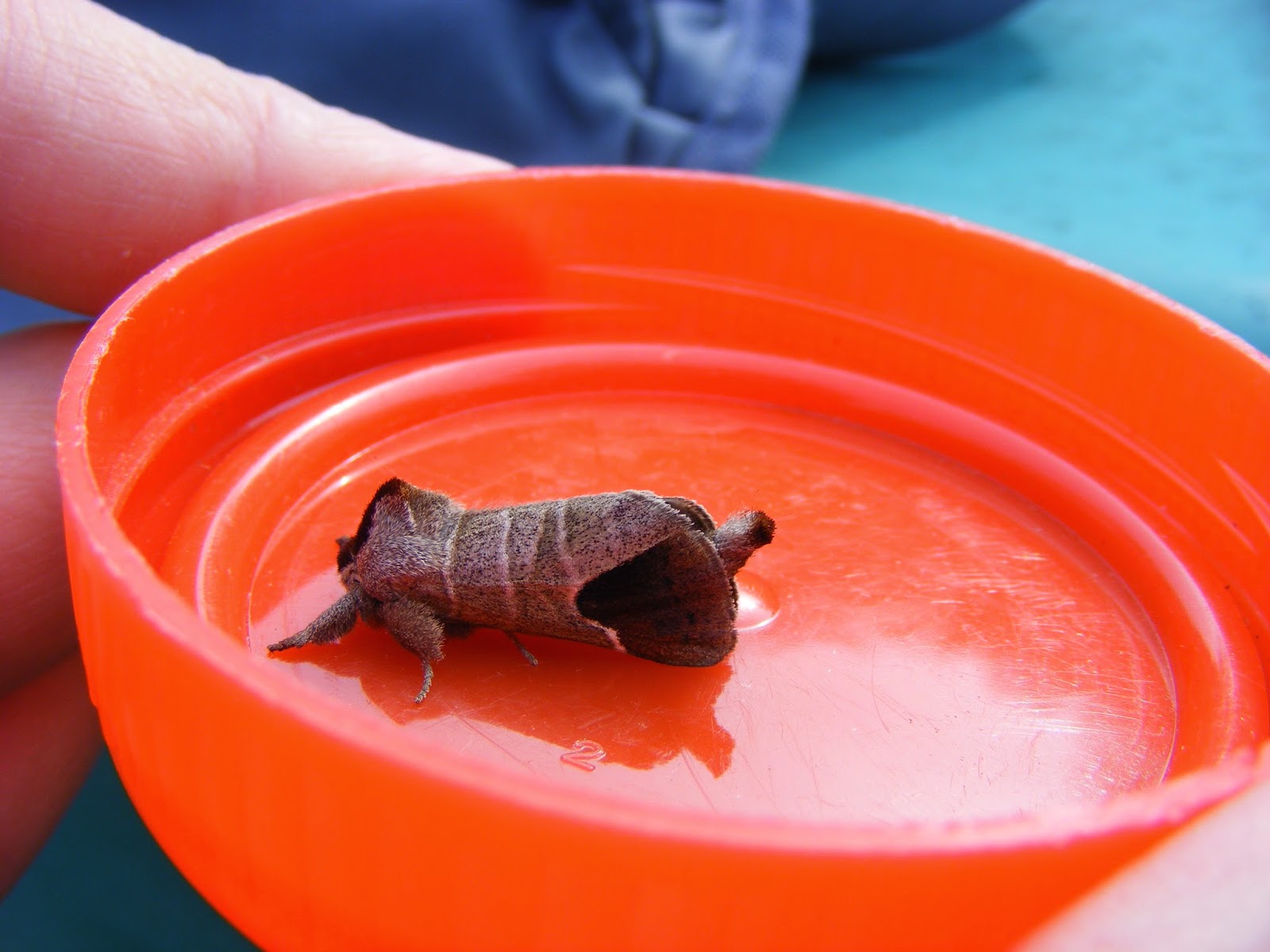
But my favourite of the day was probably this Chocolate-tip (Clostera curtula). Moths are masters of camouflage and this one looks just like a piece of broken twig.


Chocolate-tip

Thursday, April 16, 2015

Marvellous Moths

Last week heralded the start of this year's moth trapping at Preston Montford and now the warmer weather has arrived we'll be monitoring them at least once a week. We use a 'skinner trap' - a plywood box with a mercury vapour bulb on top and plastic 'baffles' that allow the moths to fall into the box (but make it difficult for them to escape) which we fill with empty egg cartons and set out in a suitable location in the evening. Many moths are feeding on sallow (willow) blossom at the moment, so one of the key areas for monitoring is near our ponds. Light-trapping is a very effective way of finding out which species of moths we have on the estate and our skinner trap does not harm them - any moths that are attracted to the light and fall into the box can rest safety in the egg cartons until morning and they are released after we have identified and counted them.
Skinner trap


Many people think of moths as the brown, drab cousins of butterflies, and although its true that many moths are well camouflaged, once you start to study them you'll find many are beautiful and very colourful. There are only 59 species of butterfly that breed regularly in the UK and Ireland but there are over 880 species of macro-moth (and around 2500 moth species if you include micro-moths as well). With practice, it is easy to learn some of the commoner species, but it does take a while to become an expert so a good moth book really helps with identification. Luckily our first trapping session coincided with an Open University Pollinators course that was being run at Preston Montford so there were several experts on hand to help. 

Here are some of the moths we've caught this month.


Common Quaker

Early Grey

Pine Beauty

Purple Thorn

Red Sword-grass

Streamer

Twin-spotted Quaker

Different moths are active at different times of the year, and there are some real beauties out there, so watch this space - we'll be posting more pictures throughout the season.....

Sunday, March 22, 2015

The Solar Eclipse


On Friday 20th March 2015 the UK witnessed one of the magical phenomena of our solar system, a partial solar eclipse. Millions of people across the world gathered outside to take the opportunity to view the eclipse. All of Preston Montford's staff, along with students from Bilborough College and Newcastle Under Lyme joined in to the watch the event happen. It was estimated that around 90% of the sun's rays were blocked by the moon at a peak time of 9.31am in Shrewsbury. 


 Handmade pinhole projectors made by our Education Assistants allowed everyone to view the eclipse safely without damaging their eyes. These allowed sun light to pass through a small hole and then project an image onto a piece of white paper behind it. A few kitchen colanders were also used to produce multiple projections of the eclipse.   


Luckily for us the weather stayed fine with no cloud, making the conditions perfect for viewing the eclipse. All staff and students remained outside till the maximum eclipse had passed, getting everyone awake and ready for a full day of teaching ahead.


 If you missed this one the next partial eclipse will be in 2026. See you there!